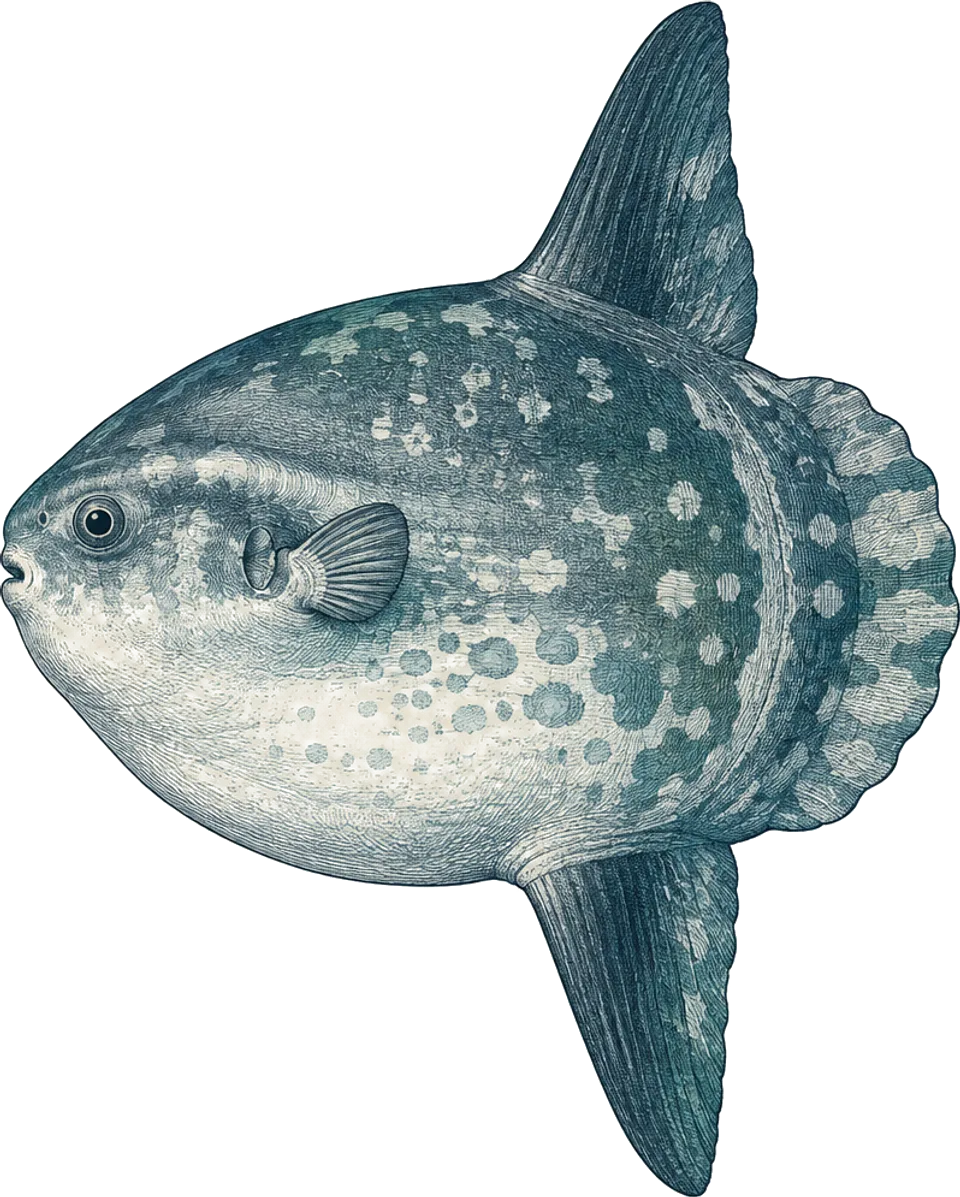
ocean sunfish (mola)
Jun–NovPunta Vicente Roca
Watch the blue off the wall near the cold thermocline; they are shy, so stay still.2
Frequent in the cold season; never guaranteed.
The best time to dive western Isabela and Fernandina is June to November, when cold upwelling brings mola to Punta Vicente Roca and penguins feed close in. Marine iguanas graze underwater all year. I'd go for the mola and pack the thickest suit I own.
Operators say: June to November, the cold upwelling season, for mola and penguins. Our data weighs sea and sky only and picks October to January; operators choose the coldest months for wildlife.

By Eugen. Based on 10 sources, checked 12 November 2026.
111 km across · coastline from Natural Earth 10m
The west coast of Isabela and the island of Fernandina face the Cromwell Current, which upwells cold, nutrient-rich water along the volcanic walls. That gives the coldest diving in the Galapagos, down to about 16 °C, and the species that do not appear elsewhere: mola in the blue at Punta Vicente Roca, marine iguanas grazing algae at Cabo Douglas, Galapagos penguins and flightless cormorants in the shallows, plus red-lipped batfish and Galapagos bullhead sharks on the bottom.
Only liveaboards dive here, usually for a day on the way to or from Darwin and Wolf. June to November is the season operators favour, when the water is coldest and mola most likely. December to May is warmer and calmer but still cold by tropical standards.
Hover a month to isolate it.
| January | February | March | April | May | June | July | August | September | October | November | December | |
|---|---|---|---|---|---|---|---|---|---|---|---|---|
| Conditions | Good | Moderate | Poor | Moderate | Poor | Good | Good | Good | Moderate | Good | Good | Excellent |
| Water temp (°C) | 24 | 25 | 26 | 25 | 23 | 23 | 22 | 21 | 21 | 21 | 21 | 22 |
| Visibility (m) | 10–20 | 10–20 | 10–20 | 10–20 | 10–20 | 10–20 | 10–20 | 10–20 | 10–20 | 10–20 | 10–20 | 10–20 |
| Marine life | Peak | Peak | Peak | Peak | Peak | Peak | Peak | Peak | Peak | Peak | Peak | Peak |
| Best time | Peak | Peak | Peak | Peak | Peak | Peak |
Long-term averages, 2016–2025. Visibility is estimated from satellite chlorophyll-a. Water temperature is the surface mean; it is cooler at depth.
Diving conditionsIt rains more.
Diving conditionsIt rains more.
Diving conditionsSwell is common, and crossings can be rough.
Diving conditionsIt rains less.
Marine lifeGalapagos sea lion (near-guaranteed), Ocean sunfish (hit-or-miss), Oceanic manta (hit-or-miss) peak at Western (Isabela/Fernandina), Galapagos in these months.
1,991 underwater observation records · 29 surveyed years of ocean data · 10 years of sea temperature
Dashed: monthly average. Band: eight days in ten.
10th to 90th percentile rangemonthly mean
Seas top 2.5 m on 2% of days. Enough to cancel a liveaboard crossing
Gusts over 40 km/h, about where a day boat stays in port
2 of them bring heavy rain
| Month | Swell | Gusts over 40 km/h | Wet days | Heavy rain | Air | Daylight |
|---|---|---|---|---|---|---|
| Jan | 2.0 m | 0% | 20 | 2 | 29 °C | 12.0 h |
| Feb | 1.8 m | 0% | 24 | 5 | 29 °C | 12.0 h |
| Mar | 1.9 m | 0% | 23 | 7 | 29 °C | 12.0 h |
| Apr | 2.0 m | 0% | 22 | 3 | 29 °C | 12.0 h |
| May | 2.5 m | 0% | 12 | 0 | 29 °C | 12.0 h |
| Jun | 2.2 m | 0% | 4 | 0 | 29 °C | 12.0 h |
| Jul | 2.2 m | 0% | 3 | 0 | 28 °C | 12.0 h |
| Aug | 2.1 m | 0% | 1 | 0 | 28 °C | 12.0 h |
| Sep | 2.2 m | 0% | 1 | 0 | 27 °C | 12.0 h |
| Oct | 2.1 m | 0% | 3 | 0 | 28 °C | 12.0 h |
| Nov | 2.0 m | 0% | 3 | 0 | 28 °C | 12.0 h |
| Dec | 1.8 m | 0% | 7 | 0 | 28 °C | 12.0 h |
Swell is the rough end of the month: nine days in ten come in under it. Sea temperature covers 10 years, waves 4.
Darker is better, against this site's own year. Pick a month for its weeks.
| Week 1 | ||||||||||||
|---|---|---|---|---|---|---|---|---|---|---|---|---|
| Week 2 | ||||||||||||
| Week 3 | ||||||||||||
| Week 4 |
| Week | Conditions | Water | Swell | Wind | Rain chance |
|---|---|---|---|---|---|
| Week 1 | Excellent | 23 °C | 2.1 m | 8 km/h | 41% |
| Week 2 | Moderate | 23 °C | 2.0 m | 7 km/h | 58% |
| Week 3 | Good | 24 °C | 1.9 m | 7 km/h | 74% |
| Week 4 | Good | 24 °C | 1.9 m | 7 km/h | 81% |
| Week 1 | Moderate | 25 °C | 1.8 m | 7 km/h | 81% |
| Week 2 | Moderate | 25 °C | 1.8 m | 7 km/h | 86% |
| Week 3 | Moderate | 25 °C | 1.8 m | 7 km/h | 87% |
| Week 4 | Moderate | 26 °C | 1.8 m | 7 km/h | 82% |
| Week 1 | Poor | 26 °C | 1.8 m | 8 km/h | 77% |
| Week 2 | Poor | 26 °C | 1.8 m | 8 km/h | 75% |
| Week 3 | Poor | 26 °C | 1.9 m | 8 km/h | 74% |
| Week 4 | Poor | 26 °C | 1.9 m | 8 km/h | 71% |
| Week 1 | Moderate | 25 °C | 1.9 m | 7 km/h | 73% |
| Week 2 | Moderate | 25 °C | 2.0 m | 7 km/h | 75% |
| Week 3 | Moderate | 25 °C | 2.0 m | 7 km/h | 73% |
| Week 4 | Poor | 24 °C | 2.1 m | 7 km/h | 68% |
| Week 1 | Poor | 24 °C | 2.2 m | 7 km/h | 62% |
| Week 2 | Poor | 24 °C | 2.3 m | 7 km/h | 52% |
| Week 3 | Moderate | 23 °C | 2.5 m | 7 km/h | 30% |
| Week 4 | Moderate | 23 °C | 2.5 m | 7 km/h | 18% |
| Week 1 | Moderate | 23 °C | 2.4 m | 8 km/h | 16% |
| Week 2 | Moderate | 23 °C | 2.3 m | 8 km/h | 14% |
| Week 3 | Good | 22 °C | 2.0 m | 8 km/h | 12% |
| Week 4 | Good | 22 °C | 2.0 m | 8 km/h | 13% |
| Week 1 | Moderate | 22 °C | 2.2 m | 8 km/h | 12% |
| Week 2 | Moderate | 22 °C | 2.2 m | 8 km/h | 10% |
| Week 3 | Moderate | 22 °C | 2.1 m | 9 km/h | 11% |
| Week 4 | Good | 22 °C | 1.9 m | 8 km/h | 8% |
| Week 1 | Good | 21 °C | 1.9 m | 8 km/h | 4% |
| Week 2 | Good | 21 °C | 2.0 m | 8 km/h | 3% |
| Week 3 | Good | 21 °C | 2.1 m | 8 km/h | 3% |
| Week 4 | Moderate | 21 °C | 2.4 m | 8 km/h | 5% |
| Week 1 | Moderate | 21 °C | 2.3 m | 8 km/h | 8% |
| Week 2 | Moderate | 21 °C | 2.4 m | 8 km/h | 5% |
| Week 3 | Good | 21 °C | 2.3 m | 8 km/h | 1% |
| Week 4 | Good | 21 °C | 2.0 m | 8 km/h | 2% |
| Week 1 | Good | 21 °C | 2.1 m | 8 km/h | 5% |
| Week 2 | Good | 21 °C | 2.1 m | 9 km/h | 9% |
| Week 3 | Moderate | 21 °C | 2.1 m | 9 km/h | 11% |
| Week 4 | Moderate | 21 °C | 2.1 m | 8 km/h | 11% |
| Week 1 | Good | 21 °C | 2.0 m | 9 km/h | 11% |
| Week 2 | Good | 21 °C | 2.0 m | 9 km/h | 9% |
| Week 3 | Good | 22 °C | 2.1 m | 9 km/h | 7% |
| Week 4 | Good | 22 °C | 2.1 m | 9 km/h | 12% |
| Week 1 | Excellent | 22 °C | 1.8 m | 8 km/h | 20% |
| Week 2 | Excellent | 22 °C | 1.7 m | 8 km/h | 21% |
| Week 3 | Excellent | 22 °C | 1.8 m | 8 km/h | 21% |
| Week 4 | Good | 22 °C | 2.0 m | 8 km/h | 26% |
10 years of daily records, averaged into weeks.
Sized for each month's coldest water.
| Jan | Feb | Mar | Apr | May | Jun | Jul | Aug | Sep | Oct | Nov | Dec | |
|---|---|---|---|---|---|---|---|---|---|---|---|---|
| Suit | 5 mm | 5 mm | 3 mm | 5 mm | 5 mm | 5 mm | 5 mm + | 5 mm + | 5 mm + | 5 mm + | 5 mm + | 5 mm + |
Suit row is for surface water. At depth: 7 mm suit or thicker, or a drysuit, with hood and gloves. SMB essential, as pangas and snorkellers use the same caves and coves.
Each month's rough end: nine days in ten are calmer.
Amber is over 2.5 m.
No tropical storm has come within 250 km in 30 years of records. Swell and wind set the season, not cyclones.
| Species | When | Observed window | Reliability | Evidence | Records |
|---|---|---|---|---|---|
| Galapagos sea lion | All year | Near-guaranteed | 493 | ||
| Galapagos penguin | All year | Near-guaranteed | 330 | ||
| Green turtle | All year | Near-guaranteed | 363 | ||
| Bump-head sunfish | All year | Likely | 41 | ||
| Marine iguana | All year | Likely | 248 | ||
| Ocellated eagle ray | All year | Likely | 31 | ||
| Bottlenose dolphin | All year | Likely | 73 | ||
| Orca | All year | Hit-or-miss | 39 | ||
| Humpback whale | Aug–Oct | Hit-or-miss | 28 | ||
| Common dolphin | All year | Hit-or-miss | 79 | ||
| Sperm whale | All year | Hit-or-miss | 83 | ||
| Bryde's whale | Oct–Dec | Hit-or-miss | 40 | ||
| Ocean sunfish | Sep–Nov | Hit-or-miss | 12 | ||
| Blue whale | Aug | Hit-or-miss | 13 | ||
| Whitetip reef shark | Dec–Jan, Jul, Oct | Likely | 29 | ||
| Oceanic manta | Feb, Apr, Jun, Oct | Hit-or-miss | 24 | ||
| Short-finned pilot whale | Jan, Jul–Aug, Oct | Hit-or-miss | 20 | ||
| Minke whale | Mar, Jul–Aug | Hit-or-miss | 8 |
Logged sightings, not a full survey. How to read this table.
| Site | Depth | Level | What to expect |
|---|---|---|---|
| Punta Vicente Rocawall | 10–28 m | Advanced | North-west Isabela: wall to about 28 m and sand at 18 to 22 m. Mola in the blue, batfish, bullhead sharks, seahorses; often drifted.2 |
| Cabo Douglaslava reef | 5–33 m | Advanced | Fernandina: marine iguanas feed at 5 to 10 m, penguins and flightless cormorants in the shallows; batfish and seahorses deeper. Swell near shore. The dive I'd most want to log.3 |
| Roca Redondavolcanic pinnacle | ≈ 10–30 m | Experienced | Rock west of Isabela with gas bubbles rising from the seabed. Hammerheads, Galapagos and silky sharks; washing-machine entry and down-currents.1 |
| Las Marielasslope | 5–25 m | Advanced | West coast of Isabela: from 5 m to past 25 m with penguins, marine iguanas, sea lions and fur seals; surge in the shallows.1 |
Punta Vicente Roca
Watch the blue off the wall near the cold thermocline; they are shy, so stay still.2
Frequent in the cold season; never guaranteed.
Cabo Douglas, Las Marielas
Shallow dive at 5 to 10 m along the lava shore where iguanas graze algae.4
Present all year; feed underwater most in the warm season.
Las Marielas, Cabo Douglas, Punta Vicente Roca
In the shallows near shore, or on snorkel and panga stops between dives.2
Likely; better on snorkel stops than on dives.
Punta Vicente Roca, Cabo Douglas
Search the sand and rubble at 18 to 30 m.1
Resident; regular with a sharp-eyed guide.
Compiled from the sources above, last checked 2026-11-12. Monthly conditions come from our own climate records; see how we score.