
Caribbean reef shark
All yearShark Arena and Runway Wall
Kneel on the sand at about 12 m behind the feeder; keep hands in and still.7
Near-certain on the feed dive; sharks often 2.5 m or more.
The best time to dive Nassau and Andros is January to May, the dry season, with 24 to 27 °C water and 20 to 30 m visibility. Diving runs all year, but I'd avoid August to October, the riskiest part of hurricane season.
Operators say: Year-round diving; January to May is the dry, settled stretch. Operators sell summer for calm, warm water. Our data also rates December and June excellent and July good; from August to November hurricane risk outweighs the flat seas.
111 km across · coastline from Natural Earth 10m
Nassau and Andros face each other across the Tongue of the Ocean, a trench about 6,000 ft (1,800 m) deep. On New Providence most diving is a short boat ride from the south-west coast: shallow reefs at Goulding Cay, film-set wrecks such as the James Bond wrecks, sunk ships like the Ray of Hope, and Stuart Cove's shark dive at about 12 m. Walls start from about 35 ft (11 m) and the trench brings pelagics close to shore.
Andros, the largest island in the Bahamas, sits behind a barrier reef more than 130 miles (210 km) long. Small Hope Bay Lodge, the island's long-running dive operation, dives the reef, deep walls such as Whip Wire Wall, and ocean blue holes, most within 15 minutes of its dock. Water runs from about 24 °C in winter to 29 °C in late summer.
Hover a month to isolate it.
| January | February | March | April | May | June | July | August | September | October | November | December | |
|---|---|---|---|---|---|---|---|---|---|---|---|---|
| Conditions | Excellent | Excellent | Excellent | Excellent | Excellent | Excellent | Good | Poor | Poor | Poor | Poor | Excellent |
| Water temp (°C) | 25 | 25 | 25 | 26 | 27 | 28 | 29 | 30 | 30 | 29 | 28 | 26 |
| Visibility (m) | 5–15 | 5–15 | 5–15 | 5–15 | 5–15 | 5–15 | 5–15 | 5–15 | 5–15 | 5–15 | 5–15 | 5–15 |
| Marine life | Steady | Steady | Busy | Busy | Busy | Steady | Steady | Busy | Steady | Steady | Steady | Busy |
| Best time | Peak | Peak | Peak | Peak | Peak |
Long-term averages, 2016–2025. Visibility is estimated from satellite chlorophyll-a. Water temperature is the surface mean; it is cooler at depth.
Diving conditionsIt rains more.
Diving conditionsIt rains less.
336 underwater observation records · 26 surveyed years of ocean data · 10 years of sea temperature
Dashed: monthly average. Band: eight days in ten.
10th to 90th percentile rangemonthly mean
Seas top 1.5 m on 6% of days. Enough to cancel a day boat
Gusts over 40 km/h, about where a day boat stays in port
3 of them bring heavy rain
| Month | Swell | Gusts over 40 km/h | Wet days | Heavy rain | Air | Daylight |
|---|---|---|---|---|---|---|
| Jan | 1.4 m | 0% | 9 | 1 | 25 °C | 10.6 h |
| Feb | 1.3 m | 0% | 8 | 1 | 26 °C | 11.2 h |
| Mar | 1.4 m | 0% | 7 | 1 | 26 °C | 11.8 h |
| Apr | 1.3 m | 0% | 11 | 2 | 28 °C | 12.6 h |
| May | 1.0 m | 0% | 16 | 4 | 29 °C | 13.2 h |
| Jun | 0.9 m | 0% | 21 | 5 | 30 °C | 13.5 h |
| Jul | 0.9 m | 0% | 21 | 4 | 31 °C | 13.4 h |
| Aug | 1.0 m | 0% | 22 | 4 | 31 °C | 12.9 h |
| Sep | 1.0 m | 1% | 22 | 5 | 30 °C | 12.1 h |
| Oct | 1.7 m | 1% | 20 | 4 | 29 °C | 11.4 h |
| Nov | 1.7 m | 0% | 13 | 2 | 27 °C | 10.8 h |
| Dec | 1.8 m | 0% | 10 | 1 | 26 °C | 10.5 h |
Swell is the rough end of the month: nine days in ten come in under it. Sea temperature covers 10 years, waves 4.
Darker is better, against this site's own year. Pick a month for its weeks.
| Week 1 | ||||||||||||
|---|---|---|---|---|---|---|---|---|---|---|---|---|
| Week 2 | ||||||||||||
| Week 3 | ||||||||||||
| Week 4 |
| Week | Conditions | Water | Swell | Wind | Rain chance |
|---|---|---|---|---|---|
| Week 1 | Excellent | 25 °C | 1.2 m | 19 km/h | 33% |
| Week 2 | Good | 25 °C | 1.3 m | 20 km/h | 36% |
| Week 3 | Excellent | 25 °C | 1.4 m | 20 km/h | 25% |
| Week 4 | Excellent | 25 °C | 1.5 m | 21 km/h | 21% |
| Week 1 | Excellent | 25 °C | 1.5 m | 21 km/h | 24% |
| Week 2 | Excellent | 25 °C | 1.5 m | 22 km/h | 24% |
| Week 3 | Excellent | 25 °C | 1.3 m | 22 km/h | 27% |
| Week 4 | Excellent | 25 °C | 1.2 m | 20 km/h | 29% |
| Week 1 | Excellent | 25 °C | 1.2 m | 21 km/h | 26% |
| Week 2 | Excellent | 25 °C | 1.4 m | 22 km/h | 23% |
| Week 3 | Excellent | 25 °C | 1.2 m | 21 km/h | 22% |
| Week 4 | Excellent | 25 °C | 1.3 m | 21 km/h | 23% |
| Week 1 | Excellent | 25 °C | 1.3 m | 20 km/h | 26% |
| Week 2 | Excellent | 25 °C | 1.2 m | 20 km/h | 33% |
| Week 3 | Good | 26 °C | 1.4 m | 21 km/h | 39% |
| Week 4 | Good | 26 °C | 1.4 m | 21 km/h | 41% |
| Week 1 | Excellent | 26 °C | 1.2 m | 20 km/h | 42% |
| Week 2 | Excellent | 27 °C | 1.0 m | 19 km/h | 50% |
| Week 3 | Excellent | 27 °C | 0.9 m | 19 km/h | 55% |
| Week 4 | Excellent | 27 °C | 0.9 m | 19 km/h | 54% |
| Week 1 | Excellent | 28 °C | 1.0 m | 17 km/h | 64% |
| Week 2 | Excellent | 28 °C | 0.9 m | 16 km/h | 69% |
| Week 3 | Excellent | 29 °C | 0.9 m | 16 km/h | 67% |
| Week 4 | Excellent | 29 °C | 0.9 m | 17 km/h | 67% |
| Week 1 | Excellent | 29 °C | 0.8 m | 17 km/h | 66% |
| Week 2 | Good | 29 °C | 0.9 m | 17 km/h | 64% |
| Week 3 | Good | 29 °C | 0.9 m | 18 km/h | 69% |
| Week 4 | Good | 30 °C | 1.0 m | 18 km/h | 69% |
| Week 1 | Poor | 30 °C | 1.0 m | 18 km/h | 69% |
| Week 2 | Poor | 30 °C | 0.9 m | 17 km/h | 71% |
| Week 3 | Poor | 30 °C | 1.0 m | 18 km/h | 70% |
| Week 4 | Poor | 30 °C | 1.0 m | 19 km/h | 72% |
| Week 1 | Poor | 30 °C | 0.8 m | 17 km/h | 72% |
| Week 2 | Poor | 30 °C | 0.8 m | 16 km/h | 72% |
| Week 3 | Poor | 30 °C | 0.8 m | 15 km/h | 76% |
| Week 4 | Poor | 30 °C | 1.2 m | 16 km/h | 75% |
| Week 1 | Moderate | 29 °C | 1.2 m | 18 km/h | 71% |
| Week 2 | Moderate | 29 °C | 1.2 m | 19 km/h | 70% |
| Week 3 | Poor | 29 °C | 1.6 m | 19 km/h | 62% |
| Week 4 | Poor | 29 °C | 1.9 m | 21 km/h | 55% |
| Week 1 | Poor | 28 °C | 2.0 m | 21 km/h | 56% |
| Week 2 | Poor | 28 °C | 1.8 m | 21 km/h | 50% |
| Week 3 | Moderate | 27 °C | 1.4 m | 19 km/h | 38% |
| Week 4 | Moderate | 27 °C | 1.3 m | 18 km/h | 34% |
| Week 1 | Excellent | 27 °C | 1.5 m | 19 km/h | 33% |
| Week 2 | Good | 26 °C | 2.0 m | 20 km/h | 38% |
| Week 3 | Good | 26 °C | 2.1 m | 21 km/h | 36% |
| Week 4 | Excellent | 26 °C | 1.4 m | 20 km/h | 28% |
10 years of daily records, averaged into weeks.
Sized for each month's coldest water.
| Jan | Feb | Mar | Apr | May | Jun | Jul | Aug | Sep | Oct | Nov | Dec | |
|---|---|---|---|---|---|---|---|---|---|---|---|---|
| Suit | 3 mm | 3 mm | 3 mm | 3 mm | 3 mm | skin | skin | skin | skin | skin | 3 mm | 3 mm |
Suit row is for surface water. At depth: 3 mm full suit or shorty in summer, 5 mm for long or deep winter dives. A torch for the blue holes. SMB for wall dives.
Each month's rough end: nine days in ten are calmer.
Amber is over 1.5 m.
7 of the last 30 Septembers saw a tropical storm pass within 250 km. Anything has been recorded Jul–Nov.
Share of the last 30 years with a storm that month.
| Species | When | Observed window | Reliability | Evidence | Records |
|---|---|---|---|---|---|
| Green turtle | All year | Likely | 46 | ||
| Southern stingray | All year | Likely | 26 | ||
| Nurse shark | All year | Likely | 26 | ||
| Bottlenose dolphin | Mar, May | Likely | 20 | ||
| Spotted eagle ray | All year | Likely | 15 | ||
| Lemon shark | Jun | Hit-or-miss | 12 | ||
| Nassau grouper | Apr–May, Aug, Dec | Likely | 47 | ||
| Sperm whale | May, Aug | Hit-or-miss | 64 | ||
| Short-finned pilot whale | Apr, Nov | Hit-or-miss | 18 |
Logged sightings, not a full survey. How to read this table.
| Site | Depth | Level | What to expect |
|---|---|---|---|
| Shark Arena and Runway Wallwall / shark feed | 10–12 m | Open Water | Stuart Cove's two-tank shark dive: watch Caribbean reef sharks gather at the wall, then kneel on sand at about 12 m for the feed.1 |
| Ray of Hopewreck | 12–18 m | Open Water | 60 m cargo ship sunk in 2003, bow at 12 m, stern at 18 m. Open holds and passageways; interior for qualified divers.1 |
| Bahama Mamawreck | 10–15 m | Open Water | 29 m former party boat on sand at 15 m, sunk in 1995. Moray eels, juvenile fish and passing reef sharks.1 |
| James Bond Wrecks (Vulcan Bomber and Tears of Allah)wreck | 8–12 m | Open Water | Film props at about 12 m: the Vulcan bomber frame from Thunderball and the Tears of Allah freighter from Never Say Never Again. Fun, if not pretty.1 |
| Lost Blue Holeblue hole | 12–30 m | Advanced | About 30 m wide, rim at 12 m, floor near 60 m. Nurse sharks, rays and turtles on the rim; blacknose sharks deeper in summer.1 |
| Cessna Wreck and Clifton Wallwreck / wall | 18–30 m | Advanced | Cessna 310 from a Jaws film at 18 m beside the wall top at 20 m. Grey reef sharks and jacks; changeable current.1 |
| Periwinkle Reefreef | 3–8 m | Open Water | Shallow reef to 8 m with sea fans, violet corals, parrotfish and stingrays. Mild current; often the last dive of the day.1 |
| Goulding Cayreef | 2–8 m | Open Water | Reefs around an uninhabited cay off New Providence's west end, rising from about 8 m to the surface. Used for first-timers and long, shallow dives.7 |
| Ocean Blue Hole (Andros)blue hole | ≈ 10–32 m | Experienced | Enter through a crevice and drop past a halocline; the floor is near 100 m. Dived on air to about 32 m. Bring a torch.5 |
| Whip Wire Wall (Andros)wall | ≈ 27–40 m | Experienced | Near-vertical wall over the Tongue of the Ocean, top at about 27 m, whip and wire corals reaching into the blue. Deep air dive; I'd save it for later.5 |
| The Marion (Andros)wreck | 12–21 m | Advanced | Barge sunk as an artificial reef, with tractor and crane, on the bottom at about 21 m. No current; dived by day and night.6 |
Shark Arena and Runway Wall
Kneel on the sand at about 12 m behind the feeder; keep hands in and still.7
Near-certain on the feed dive; sharks often 2.5 m or more.
Lost Blue Hole
Look down from the rim of the Lost Blue Hole; they gather near the bottom.1
Seasonal, best May to early August.
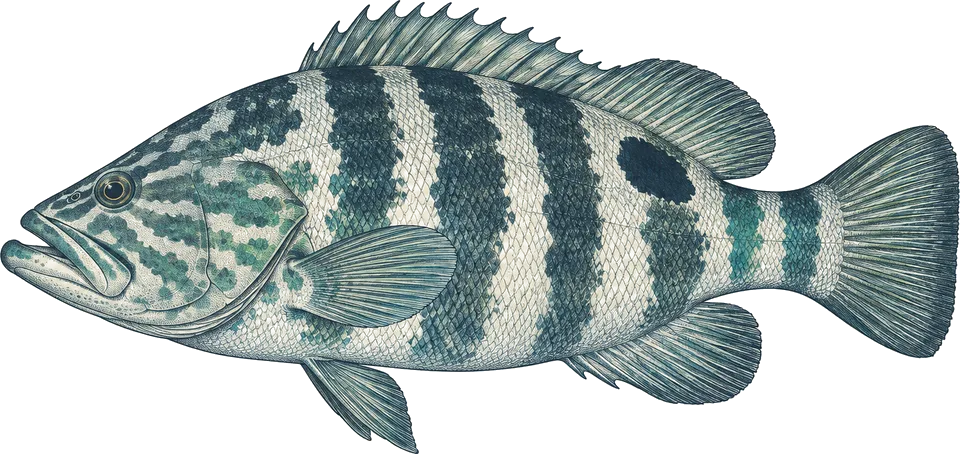
Shark Arena and Runway Wall
Watch the sand and reef edge during the shark dive; groupers join the feed.7
Regular at the shark-feed site.
Compiled from the sources above, last checked 2026-11-12. Monthly conditions come from our own climate records; see how we score.