
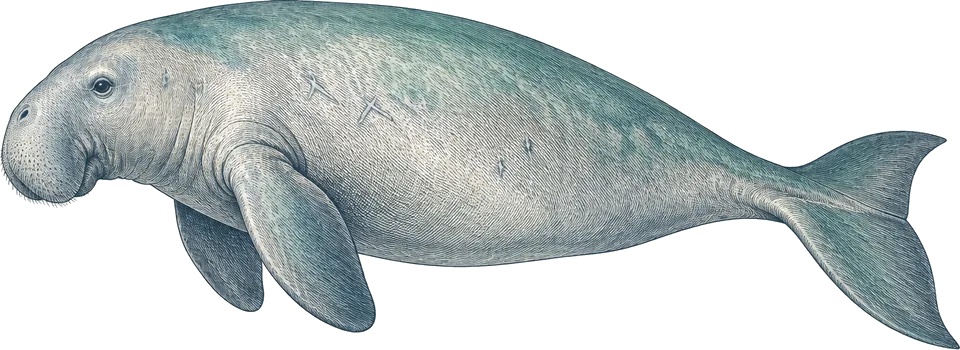
dugong
All yearVanuatu's coastal seagrass areas
Keep still and low if one appears; never chase.5
Occasional; not something to plan a trip around.
The best time to dive Vanuatu is May to October, outside the November to April cyclone season and the January to April rains. The SS President Coolidge is diveable all year, and honestly, she's the reason to go.
Operators say: May to October, outside cyclone season; the Coolidge can be dived all year. Our sea and wind data rates June to September highest and scores November well too; we still avoid November because cyclones run November to April, most often December to March.
Worth knowing: 27% of years see a tropical storm pass within 250 km.
111 km across · coastline from Natural Earth 10m
Vanuatu's best-known dive is the SS President Coolidge, a troopship and former luxury liner that struck a mine off Espiritu Santo during the Second World War and slid back down the reef slope. She lies on her side from about 20 m at the bow to 70 m at the stern, close enough to be dived from shore, and divers usually spend a week or more working through her: cargo holds, the porcelain Lady and unicorn in the first-class dining room, the engine room and the stern. Nearly every dive has decompression stops. Next door, Million Dollar Point is a slope of military equipment dumped by the United States after the war.
Around Port Vila on Efate there are deliberately sunk wrecks, a sunlit cavern and reefs with walls and swim-throughs. Diving runs all year, with water from about 24 °C in August to 29 °C from January to May. Cyclones are possible from November to April, most often December to March, so May to October is the safer window.
Hover a month to isolate it.
| January | February | March | April | May | June | July | August | September | October | November | December | |
|---|---|---|---|---|---|---|---|---|---|---|---|---|
| Conditions | Poor | Poor | Poor | Moderate | Good | Excellent | Excellent | Excellent | Excellent | Good | Excellent | Good |
| Water temp (°C) | 29 | 29 | 29 | 29 | 28 | 28 | 27 | 27 | 27 | 28 | 28 | 29 |
| Visibility (m) | 5–15 | 5–15 | 10–20 | 10–20 | 5–15 | 5–15 | 10–20 | 15–25 | 15–25 | 10–20 | 5–15 | 5–15 |
| Marine life | Quiet | Steady | Busy | Steady | Steady | Steady | Busy | Steady | Quiet | Steady | Steady | Busy |
| Best time | Peak | Peak | Peak | Peak | Peak | Peak |
Long-term averages, 2016–2025. Visibility is estimated from satellite chlorophyll-a. Water temperature is the surface mean; it is cooler at depth.
Diving conditionsThe wind is up. The sea is calmer.
Diving conditionsThe wind is up. The sea is calmer.
Diving conditionsThe sea is rougher. The wind eases.
81 underwater observation records · 16 surveyed years of ocean data · 10 years of sea temperature
Dashed: monthly average. Band: eight days in ten.
10th to 90th percentile rangemonthly mean
Seas top 1.5 m on 2% of days. Enough to cancel a day boat
Gusts over 40 km/h, about where a day boat stays in port
7 of them bring heavy rain
| Month | Swell | Gusts over 40 km/h | Wet days | Heavy rain | Air | Daylight |
|---|---|---|---|---|---|---|
| Jan | 0.9 m | 0% | 26 | 11 | 30 °C | 12.8 h |
| Feb | 1.2 m | 1% | 25 | 10 | 30 °C | 12.5 h |
| Mar | 0.9 m | 0% | 29 | 13 | 30 °C | 12.1 h |
| Apr | 1.0 m | 0% | 25 | 9 | 29 °C | 11.6 h |
| May | 1.3 m | 0% | 20 | 5 | 28 °C | 11.3 h |
| Jun | 1.2 m | 0% | 20 | 4 | 27 °C | 11.1 h |
| Jul | 1.5 m | 0% | 20 | 3 | 27 °C | 11.2 h |
| Aug | 1.3 m | 0% | 21 | 4 | 27 °C | 11.5 h |
| Sep | 1.3 m | 0% | 21 | 4 | 27 °C | 11.9 h |
| Oct | 1.2 m | 0% | 25 | 7 | 28 °C | 12.4 h |
| Nov | 1.0 m | 0% | 26 | 9 | 29 °C | 12.7 h |
| Dec | 0.9 m | 0% | 27 | 10 | 30 °C | 12.9 h |
Swell is the rough end of the month: nine days in ten come in under it. Sea temperature covers 10 years, waves 4.
Darker is better, against this site's own year. Pick a month for its weeks.
| Week 1 | ||||||||||||
|---|---|---|---|---|---|---|---|---|---|---|---|---|
| Week 2 | ||||||||||||
| Week 3 | ||||||||||||
| Week 4 |
| Week | Conditions | Water | Swell | Wind | Rain chance |
|---|---|---|---|---|---|
| Week 1 | Poor | 29 °C | 1.0 m | 13 km/h | 82% |
| Week 2 | Poor | 29 °C | 0.9 m | 12 km/h | 85% |
| Week 3 | Poor | 29 °C | 0.9 m | 12 km/h | 87% |
| Week 4 | Poor | 29 °C | 1.0 m | 12 km/h | 91% |
| Week 1 | Poor | 29 °C | 1.3 m | 13 km/h | 90% |
| Week 2 | Poor | 29 °C | 1.5 m | 13 km/h | 83% |
| Week 3 | Poor | 29 °C | 1.2 m | 13 km/h | 85% |
| Week 4 | Poor | 29 °C | 1.2 m | 12 km/h | 87% |
| Week 1 | Poor | 29 °C | 1.3 m | 12 km/h | 90% |
| Week 2 | Poor | 29 °C | 0.9 m | 12 km/h | 93% |
| Week 3 | Poor | 29 °C | 0.8 m | 13 km/h | 95% |
| Week 4 | Poor | 29 °C | 0.8 m | 12 km/h | 94% |
| Week 1 | Moderate | 29 °C | 0.9 m | 13 km/h | 87% |
| Week 2 | Moderate | 29 °C | 1.0 m | 14 km/h | 80% |
| Week 3 | Moderate | 29 °C | 1.0 m | 13 km/h | 81% |
| Week 4 | Moderate | 29 °C | 1.1 m | 13 km/h | 82% |
| Week 1 | Good | 29 °C | 1.3 m | 15 km/h | 77% |
| Week 2 | Good | 29 °C | 1.3 m | 17 km/h | 73% |
| Week 3 | Good | 28 °C | 1.3 m | 16 km/h | 66% |
| Week 4 | Good | 28 °C | 1.3 m | 15 km/h | 60% |
| Week 1 | Excellent | 28 °C | 1.2 m | 16 km/h | 61% |
| Week 2 | Excellent | 28 °C | 1.1 m | 16 km/h | 64% |
| Week 3 | Excellent | 28 °C | 1.1 m | 16 km/h | 68% |
| Week 4 | Excellent | 28 °C | 1.2 m | 17 km/h | 67% |
| Week 1 | Excellent | 27 °C | 1.2 m | 19 km/h | 66% |
| Week 2 | Excellent | 27 °C | 1.5 m | 18 km/h | 69% |
| Week 3 | Excellent | 27 °C | 1.6 m | 17 km/h | 69% |
| Week 4 | Excellent | 27 °C | 1.4 m | 17 km/h | 60% |
| Week 1 | Excellent | 27 °C | 1.4 m | 17 km/h | 55% |
| Week 2 | Excellent | 27 °C | 1.4 m | 17 km/h | 63% |
| Week 3 | Excellent | 27 °C | 1.3 m | 18 km/h | 71% |
| Week 4 | Excellent | 27 °C | 1.2 m | 18 km/h | 77% |
| Week 1 | Excellent | 27 °C | 1.3 m | 19 km/h | 74% |
| Week 2 | Excellent | 27 °C | 1.3 m | 18 km/h | 72% |
| Week 3 | Excellent | 27 °C | 1.1 m | 18 km/h | 71% |
| Week 4 | Excellent | 27 °C | 1.3 m | 17 km/h | 66% |
| Week 1 | Good | 27 °C | 1.4 m | 17 km/h | 76% |
| Week 2 | Good | 27 °C | 1.2 m | 16 km/h | 82% |
| Week 3 | Good | 28 °C | 1.0 m | 16 km/h | 80% |
| Week 4 | Excellent | 28 °C | 1.0 m | 15 km/h | 81% |
| Week 1 | Good | 28 °C | 1.0 m | 14 km/h | 86% |
| Week 2 | Good | 28 °C | 1.2 m | 14 km/h | 88% |
| Week 3 | Good | 28 °C | 1.0 m | 14 km/h | 83% |
| Week 4 | Good | 28 °C | 0.9 m | 14 km/h | 83% |
| Week 1 | Good | 29 °C | 0.9 m | 14 km/h | 85% |
| Week 2 | Good | 29 °C | 0.8 m | 13 km/h | 81% |
| Week 3 | Good | 29 °C | 0.8 m | 13 km/h | 86% |
| Week 4 | Good | 29 °C | 1.0 m | 13 km/h | 89% |
10 years of daily records, averaged into weeks.
Sized for each month's coldest water.
| Jan | Feb | Mar | Apr | May | Jun | Jul | Aug | Sep | Oct | Nov | Dec | |
|---|---|---|---|---|---|---|---|---|---|---|---|---|
| Suit | skin | skin | skin | skin | skin | skin | 3 mm | 3 mm | 3 mm | skin | skin | skin |
Suit row is for surface water. At depth: 3 mm most of the year. On repeated long Coolidge dives in the cooler months I'd take 5 mm. A torch for wreck interiors and a computer that handles decompression.
Each month's rough end: nine days in ten are calmer.
Amber is over 1.5 m.
8 of the last 30 Marchs saw a tropical storm pass within 250 km. Anything has been recorded Dec–Jun, Oct.
Share of the last 30 years with a storm that month.
Only 81 records have been logged within 60 km. A thin record is not an empty reef.
| Species | When | Observed window | Reliability | Evidence | Records |
|---|---|---|---|---|---|
| Dugong | Feb, Nov–Dec | Likely | 47 | ||
| Green turtle | Mar, Jul, Dec | Likely | 11 |
Logged sightings, not a full survey. How to read this table.
| Site | Depth | Level | What to expect |
|---|---|---|---|
| SS President CoolidgeVanuatu · wreck | 20–40 m | Advanced | Nearly 200 m liner on her side off Luganville, bow about 20 m, stern 70 m. Shore entry; nearly every dive needs decompression stops.1 |
| The Lady (SS President Coolidge)Vanuatu · wreck penetration | ≈ 20–40 m | Experienced | Porcelain relief of a lady riding a unicorn in the first-class dining room, reached on a deeper penetration dive.1 |
| Million Dollar PointVanuatu · debris field | ≈ 5–25 m | Open Water | Slope of tanks, jeeps, aircraft parts and bottles dumped by the US military after the war; snorkellable in the shallows, technical dives to 50 m.4 |
| Star of RussiaVanuatu · wreck | ≈ 25–34 m | Advanced | 90 m square-rigged sailing ship sitting upright on sand at 34 m off Port Vila, with fish schools and batfish around the steel hull.3 |
| Semele FederesenVanuatu · wreck | 30–40 m | Experienced | Inter-island cargo ship with its top at 30 m, lying on sand at 38 to 55 m; visibility sometimes 40 to 50 m.3 |
| Konanda WreckVanuatu · wreck | ≈ 18–26 m | Advanced | Former island trader sunk as a dive site, upright on sand at 26 m, with safe penetration into holds, cabin and bridge. The one I'd do first.3 |
| The CathedralVanuatu · cavern | ≈ 10–28 m | Advanced | Limestone cavern lit by sunbeams, entered at about 22 m, with a wall exit; shrimp, nudibranchs, leaf scorpionfish. Tricky in swell or current.3 |
| Twin BommiesVanuatu · reef | 12–18 m | Open Water | Two coral bommies on a 12 to 18 m plateau that drops to sand at 25 to 30 m; butterflyfish, nudibranchs, turtles on night dives.3 |
| West Side StoryVanuatu · reef | ≈ 6–25 m | Open Water | Reef top within 6 m of the surface with staghorn coral and anemones; coral fingers drop past 30 m. Occasional reef sharks.3 |
| Blue holes, White Grass (Tanna)Vanuatu · wall | ≈ 5–25 m | Open Water | Reef wall dropping to about 25 m off Tanna, with swim-throughs and caves and clear water.4 |
Vanuatu's coastal seagrass areas
Keep still and low if one appears; never chase.5
Occasional; not something to plan a trip around.
Twin Bommies
Night dives on the Efate reef plateaus.3
Often seen at night.
Star of Russia
Circle the hull at 30 m and look up into the water column.3
Resident around the wreck.
Compiled from the sources above, last checked 2026-11-12. Monthly conditions come from our own climate records; see how we score.