
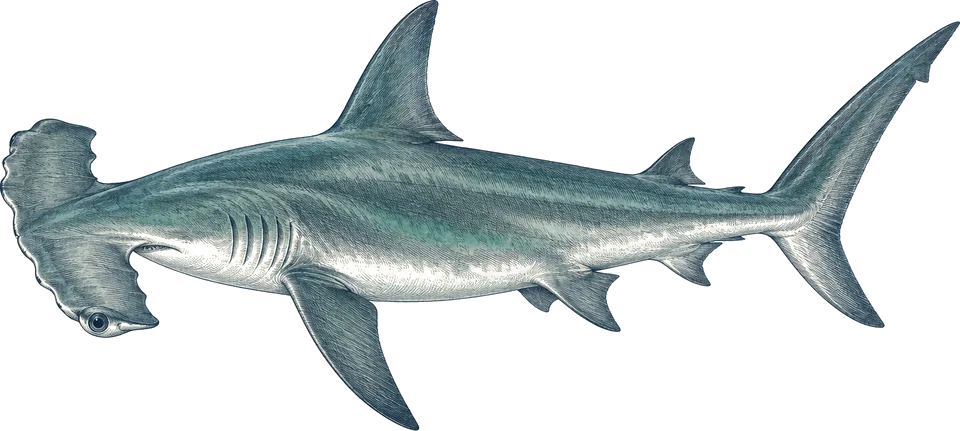
scalloped hammerhead
Mar–Apr, Sep–NovManuk, Suanggi, Nila, Serua
Deep blue-water dives off seamounts, often near the thermocline at 30 to 40 m.5
Good September to November, best October; weaker in March.
The best time to dive the Banda Sea is September to November, with October the most reliable month for schooling scalloped hammerheads and calm crossings. March and April are a shorter second window. October is the one I'd book.
Operators say: September to November, October best for hammerheads; March to April is a second window. Our data agrees on September to November and backs April, but marks March rough.
222 km across · coastline from Natural Earth 10m
The Banda Sea is open, deep water ringed by volcanic islands that rise from about 4,500 m. It is dived almost only by liveaboard, though a small dive centre has run on Banda Neira since 2024, mostly on crossings that each boat makes about once a year between Komodo or Alor and Raja Ampat, starting or ending in Ambon or Maumere. The pull is schooling scalloped hammerheads around Manuk, Suanggi, Nila and Serua, often deep at the thermocline, plus the sea snakes of Manuk, where banded sea kraits and olive sea snakes hunt with trevally.
Around Banda Neira the diving is easier: walls with gorgonians and barrel sponges, mandarinfish at dusk, and hard coral that has regrown on the lava flow from Gunung Api's 1988 eruption. The crossing windows are March to April and September to November, with October the favourite. Strong currents and remoteness make it a trip for experienced divers.
Hover a month to isolate it.
| January | February | March | April | May | June | July | August | September | October | November | December | |
|---|---|---|---|---|---|---|---|---|---|---|---|---|
| Conditions | Poor | Poor | Poor | Excellent | Poor | Poor | Poor | Poor | Excellent | Excellent | Excellent | Poor |
| Water temp (°C) | 30 | 29 | 30 | 30 | 29 | 28 | 27 | 27 | 28 | 29 | 30 | 30 |
| Visibility (m) | 20–30 | 20–30 | 20–30 | 20–30 | 20–30 | 15–25 | 15–25 | 15–25 | 15–25 | 20–30 | 20–30 | 20–30 |
| Marine life | Closed | Closed | Steady | Steady | Closed | Closed | Closed | Closed | Quiet | Peak | Busy | Closed |
| Best time | Peak | Peak | Peak |
Long-term averages, 2016–2025. Visibility is estimated from satellite chlorophyll-a. Water temperature is the surface mean; it is cooler at depth.
Diving conditionsRain is frequent topside. The wind eases. The sea is calmer.
Diving conditionsThis is the wet season topside. The wind is up. The sea is rougher.
62 underwater observation records · 8 surveyed years of ocean data · 10 years of sea temperature
Dashed: monthly average. Band: eight days in ten.
10th to 90th percentile rangemonthly mean
Seas top 2.5 m on under 1% of days. Enough to cancel a liveaboard crossing
Gusts over 40 km/h, about where a day boat stays in port
8 of them bring heavy rain
| Month | Swell | Gusts over 40 km/h | Wet days | Heavy rain | Air | Daylight |
|---|---|---|---|---|---|---|
| Jan | 1.4 m | 0% | 25 | 8 | 29 °C | 12.2 h |
| Feb | 1.5 m | 1% | 24 | 8 | 29 °C | 12.1 h |
| Mar | 1.3 m | 2% | 26 | 9 | 29 °C | 12.0 h |
| Apr | 1.0 m | 0% | 24 | 10 | 29 °C | 11.9 h |
| May | 1.8 m | 1% | 27 | 14 | 28 °C | 11.8 h |
| Jun | 1.7 m | 1% | 26 | 14 | 27 °C | 11.7 h |
| Jul | 2.0 m | 4% | 23 | 8 | 27 °C | 11.8 h |
| Aug | 1.8 m | 2% | 18 | 5 | 27 °C | 11.9 h |
| Sep | 1.5 m | 2% | 19 | 4 | 27 °C | 12.0 h |
| Oct | 0.9 m | 0% | 16 | 2 | 28 °C | 12.1 h |
| Nov | 0.8 m | 0% | 18 | 5 | 29 °C | 12.2 h |
| Dec | 1.5 m | 2% | 25 | 11 | 29 °C | 12.3 h |
Swell is the rough end of the month: nine days in ten come in under it. Sea temperature covers 10 years, waves 4.
Darker is better, against this site's own year. Pick a month for its weeks.
| Week 1 | ||||||||||||
|---|---|---|---|---|---|---|---|---|---|---|---|---|
| Week 2 | ||||||||||||
| Week 3 | ||||||||||||
| Week 4 |
| Week | Conditions | Water | Swell | Wind | Rain chance |
|---|---|---|---|---|---|
| Week 1 | Poor | 30 °C | 1.3 m | 23 km/h | 84% |
| Week 2 | Poor | 30 °C | 1.3 m | 23 km/h | 86% |
| Week 3 | Poor | 30 °C | 1.4 m | 23 km/h | 80% |
| Week 4 | Poor | 30 °C | 1.5 m | 24 km/h | 73% |
| Week 1 | Poor | 29 °C | 1.6 m | 25 km/h | 80% |
| Week 2 | Poor | 29 °C | 1.6 m | 24 km/h | 85% |
| Week 3 | Poor | 29 °C | 1.4 m | 22 km/h | 86% |
| Week 4 | Poor | 29 °C | 1.3 m | 22 km/h | 85% |
| Week 1 | Moderate | 29 °C | 1.3 m | 21 km/h | 89% |
| Week 2 | Moderate | 30 °C | 1.3 m | 20 km/h | 86% |
| Week 3 | Poor | 30 °C | 1.3 m | 19 km/h | 77% |
| Week 4 | Poor | 30 °C | 1.1 m | 20 km/h | 84% |
| Week 1 | Excellent | 30 °C | 1.0 m | 20 km/h | 86% |
| Week 2 | Good | 30 °C | 0.9 m | 17 km/h | 82% |
| Week 3 | Good | 30 °C | 0.9 m | 17 km/h | 81% |
| Week 4 | Excellent | 30 °C | 1.1 m | 19 km/h | 81% |
| Week 1 | Poor | 30 °C | 1.3 m | 22 km/h | 86% |
| Week 2 | Poor | 29 °C | 1.6 m | 25 km/h | 88% |
| Week 3 | Poor | 29 °C | 1.8 m | 26 km/h | 85% |
| Week 4 | Poor | 29 °C | 1.8 m | 27 km/h | 88% |
| Week 1 | Poor | 29 °C | 1.7 m | 27 km/h | 86% |
| Week 2 | Poor | 28 °C | 1.7 m | 28 km/h | 83% |
| Week 3 | Poor | 28 °C | 1.6 m | 29 km/h | 86% |
| Week 4 | Poor | 28 °C | 1.7 m | 29 km/h | 91% |
| Week 1 | Poor | 28 °C | 1.9 m | 29 km/h | 88% |
| Week 2 | Poor | 27 °C | 2.0 m | 31 km/h | 81% |
| Week 3 | Poor | 27 °C | 2.1 m | 31 km/h | 74% |
| Week 4 | Poor | 27 °C | 1.9 m | 30 km/h | 64% |
| Week 1 | Poor | 27 °C | 1.7 m | 30 km/h | 62% |
| Week 2 | Poor | 27 °C | 1.7 m | 29 km/h | 61% |
| Week 3 | Poor | 27 °C | 1.8 m | 29 km/h | 57% |
| Week 4 | Poor | 27 °C | 1.8 m | 29 km/h | 56% |
| Week 1 | Good | 27 °C | 1.6 m | 28 km/h | 59% |
| Week 2 | Good | 27 °C | 1.7 m | 27 km/h | 63% |
| Week 3 | Excellent | 28 °C | 1.6 m | 25 km/h | 62% |
| Week 4 | Excellent | 28 °C | 1.2 m | 22 km/h | 65% |
| Week 1 | Excellent | 28 °C | 1.1 m | 21 km/h | 66% |
| Week 2 | Excellent | 28 °C | 1.0 m | 20 km/h | 61% |
| Week 3 | Excellent | 29 °C | 0.8 m | 18 km/h | 49% |
| Week 4 | Excellent | 29 °C | 0.7 m | 16 km/h | 43% |
| Week 1 | Excellent | 30 °C | 0.7 m | 15 km/h | 46% |
| Week 2 | Excellent | 30 °C | 0.7 m | 15 km/h | 53% |
| Week 3 | Excellent | 30 °C | 0.9 m | 16 km/h | 67% |
| Week 4 | Good | 30 °C | 1.1 m | 16 km/h | 71% |
| Week 1 | Poor | 30 °C | 1.0 m | 17 km/h | 70% |
| Week 2 | Poor | 30 °C | 1.3 m | 21 km/h | 77% |
| Week 3 | Poor | 30 °C | 1.5 m | 24 km/h | 85% |
| Week 4 | Poor | 30 °C | 1.6 m | 23 km/h | 85% |
10 years of daily records, averaged into weeks.
Sized for each month's coldest water.
| Jan | Feb | Mar | Apr | May | Jun | Jul | Aug | Sep | Oct | Nov | Dec | |
|---|---|---|---|---|---|---|---|---|---|---|---|---|
| Suit | skin | skin | skin | skin | skin | skin | 3 mm | 3 mm | 3 mm | skin | skin | skin |
Suit row is for surface water. At depth: 3 mm wetsuit, or 5 mm if you feel cold on deep thermocline dives. SMB is essential in open water, plus a torch for dusk mandarinfish dives.
Each month's rough end: nine days in ten are calmer.
Amber is over 2.5 m.
1 of the last 30 Novembers saw a tropical storm pass within 250 km. November is the only month with a recorded pass.
Share of the last 30 years with a storm that month.
Only 62 records have been logged within 60 km. A thin record is not an empty reef.
| Species | When | Observed window | Reliability | Evidence | Records |
|---|---|---|---|---|---|
| Napoleon wrasse | Jan, Nov | Likely | 10 | ||
| Hawksbill turtle | Jan, May, Oct | Near-guaranteed | 17 | ||
| Bumphead parrotfish | Jan–Feb, Oct | Near-guaranteed | 9 |
Logged sightings, not a full survey. How to read this table.
| Site | Depth | Level | What to expect |
|---|---|---|---|
| Coconut Corner (Manuk)volcanic slope | ≈ 10–40 m | Experienced | Manuk's hammerhead spot: schools pass September to November; Chinese sea kraits and trevally hunt over sand with garden eels. The dive I'd go for.3 |
| Bubble Ridge (Manuk)ridge | ≈ 5–25 m | Advanced | Manuk ridge with dozens of sea snakes, sometimes hunting in packs alongside trevally.3 |
| Suanggipinnacle | 16–40 m | Experienced | Coral pinnacles from 16 m dropping past 50 m: giant trevally, barracuda, scalloped hammerheads. Visibility can drop late in the day.3 |
| Lava Flow (Banda Neira)hard coral slope | ≈ 5–20 m | Open Water | Hard coral regrown over the lava from Gunung Api's 1988 eruption, opposite Banda Neira town; some litter from the town.4 |
| Karang Hattareef | ≈ 5–25 m | Advanced | Reef off Hatta island with clouds of redtooth triggerfish, humphead parrotfish, blacktips and mobula rays; solitary hammerheads at times.3 |
| Nil Desperandumseamount | ≈ 15–35 m | Experienced | Remote seamount between Ambon and Banda: barracuda, trevally, dogtooth tuna, groupers and hawksbill turtles. Visibility can drop to 10 m.3 |
| Banda Neira wallswall | ≈ 5–25 m | Open Water | Walls, tunnels and overhangs with gorgonians, soft corals and giant barrel sponges; mandarinfish come out at sunset.2 |
Manuk, Suanggi, Nila, Serua
Deep blue-water dives off seamounts, often near the thermocline at 30 to 40 m.5
Good September to November, best October; weaker in March.
Coconut Corner, Bubble Ridge (Manuk)
Slow dives over Manuk's ridges and black sand; snakes are curious but docile.3
Near certain at Manuk; often ten or more per dive.
Bubble Ridge (Manuk), Karang Hatta
Watch the blue off ridges and reef edges.3
Occasional, sometimes in groups.
Banda Neira
Dusk dive in the shallows at about 3 to 5 m.6
Reliable at sunset.
Compiled from the sources above, last checked 2026-11-12. Monthly conditions come from our own climate records; see how we score.