
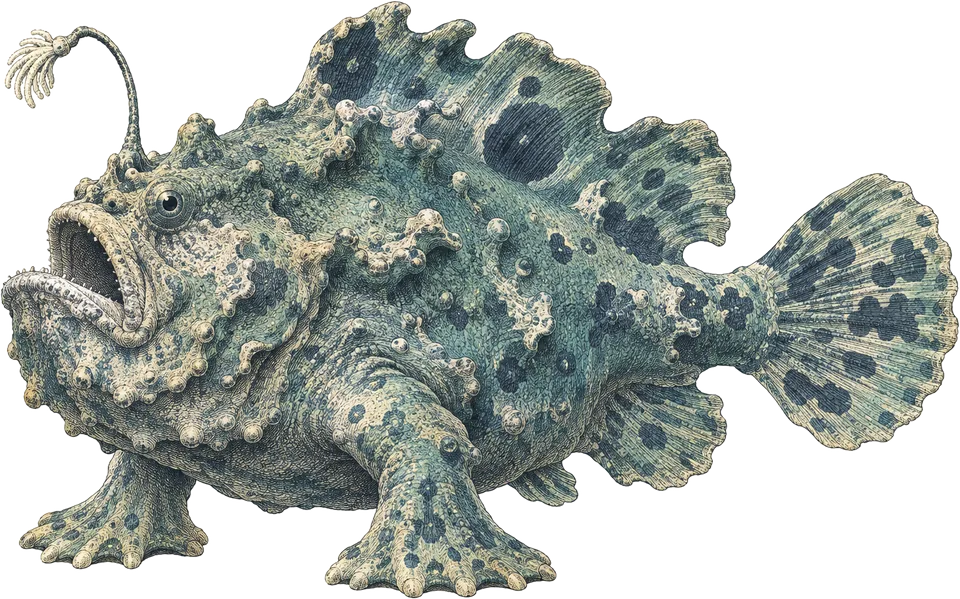
psychedelic frogfish
All yearAmbon Bay
Search shallow rubble and coral in the bay with a guide who has recent sightings.4
Rare; sightings can be months apart.
The best time to dive Ambon is October to April, the dry monsoon, when rain eases and the outer-coast walls clear. The bay's muck sites are dived all year, though some centres close in July and August. I'd go in October.
Operators say: October to April, the dry monsoon; bay muck sites are dived all year, though some centres close in July and August. Our data rates September to February best and March and April only moderate.
111 km across · coastline from Natural Earth 10m
Ambon is a muck-diving destination first. Inside Ambon Bay, black-sand and rubble slopes such as Laha, the Twilight Zone, Rhino City and Silale hold frogfish of several species, rhinopias, Ambon scorpionfish, mandarinfish and, very occasionally, the psychedelic frogfish first described from here. The SS Duke of Sparta wreck sits in the bay at 13 to 35 m. Outside the bay, the south and east coasts have walls, caves and drifts with sea fans, barracuda and dogtooth tuna.
The dry monsoon, roughly October to April, brings less rain and opens the clearer outer-coast sites. From May to August the east monsoon brings heavy rain; muck diving carries on in the bay, but some centres have closed in July and August. Ambon is also where many Banda Sea liveaboards begin or end, mostly in September to November and February to April.
Hover a month to isolate it.
| January | February | March | April | May | June | July | August | September | October | November | December | |
|---|---|---|---|---|---|---|---|---|---|---|---|---|
| Conditions | Good | Excellent | Moderate | Moderate | Poor | Poor | Poor | Moderate | Good | Excellent | Good | Good |
| Water temp (°C) | 30 | 30 | 30 | 30 | 29 | 28 | 27 | 27 | 28 | 29 | 29 | 30 |
| Visibility (m) | 15–25 | 15–25 | 15–25 | 15–25 | 10–20 | 5–15 | 5–15 | 5–15 | 5–15 | 5–15 | 10–20 | 15–25 |
| Marine life | No data | No data | No data | No data | No data | No data | No data | No data | No data | No data | No data | No data |
| Best time | Peak | Peak | Peak | Peak | Peak | Peak | Peak |
Long-term averages, 2016–2025. Visibility is estimated from satellite chlorophyll-a. Water temperature is the surface mean; it is cooler at depth.
Diving conditionsThe sea is calmer. The wind is up.
Diving conditionsThe sea is rougher. The wind eases.
Diving conditionsThe sea is rougher. The wind eases.
Diving conditionsThe wind is up. The sea is calmer.
10 years of sea temperature
Dashed: monthly average. Band: eight days in ten.
10th to 90th percentile rangemonthly mean
Seas top 1.5 m on 5% of days. Enough to cancel a day boat
Gusts over 40 km/h, about where a day boat stays in port
10 of them bring heavy rain
| Month | Swell | Gusts over 40 km/h | Wet days | Heavy rain | Air | Daylight |
|---|---|---|---|---|---|---|
| Jan | 0.9 m | 0% | 22 | 8 | 30 °C | 12.2 h |
| Feb | 1.0 m | 0% | 22 | 5 | 30 °C | 12.1 h |
| Mar | 0.8 m | 0% | 26 | 11 | 30 °C | 12.0 h |
| Apr | 0.8 m | 0% | 27 | 13 | 29 °C | 11.9 h |
| May | 1.5 m | 0% | 29 | 15 | 29 °C | 11.8 h |
| Jun | 1.4 m | 0% | 29 | 16 | 27 °C | 11.8 h |
| Jul | 1.7 m | 0% | 29 | 14 | 27 °C | 11.8 h |
| Aug | 1.5 m | 0% | 28 | 9 | 27 °C | 11.9 h |
| Sep | 1.2 m | 0% | 27 | 9 | 28 °C | 12.0 h |
| Oct | 0.8 m | 0% | 24 | 7 | 29 °C | 12.1 h |
| Nov | 0.6 m | 0% | 24 | 10 | 30 °C | 12.2 h |
| Dec | 1.0 m | 0% | 27 | 9 | 30 °C | 12.2 h |
Swell is the rough end of the month: nine days in ten come in under it. Sea temperature covers 10 years, waves 4.
Darker is better, against this site's own year. Pick a month for its weeks.
| Week 1 | ||||||||||||
|---|---|---|---|---|---|---|---|---|---|---|---|---|
| Week 2 | ||||||||||||
| Week 3 | ||||||||||||
| Week 4 |
| Week | Conditions | Water | Swell | Wind | Rain chance |
|---|---|---|---|---|---|
| Week 1 | Excellent | 30 °C | 0.8 m | 12 km/h | 74% |
| Week 2 | Excellent | 30 °C | 0.8 m | 11 km/h | 78% |
| Week 3 | Good | 30 °C | 0.9 m | 12 km/h | 76% |
| Week 4 | Good | 30 °C | 0.9 m | 14 km/h | 65% |
| Week 1 | Excellent | 30 °C | 1.0 m | 14 km/h | 67% |
| Week 2 | Excellent | 30 °C | 1.0 m | 13 km/h | 80% |
| Week 3 | Excellent | 30 °C | 0.9 m | 12 km/h | 79% |
| Week 4 | Excellent | 30 °C | 0.9 m | 12 km/h | 76% |
| Week 1 | Moderate | 30 °C | 0.8 m | 12 km/h | 83% |
| Week 2 | Moderate | 30 °C | 0.8 m | 12 km/h | 87% |
| Week 3 | Moderate | 30 °C | 0.7 m | 11 km/h | 82% |
| Week 4 | Moderate | 30 °C | 0.7 m | 11 km/h | 86% |
| Week 1 | Moderate | 30 °C | 0.7 m | 11 km/h | 89% |
| Week 2 | Moderate | 30 °C | 0.7 m | 10 km/h | 89% |
| Week 3 | Moderate | 30 °C | 0.8 m | 11 km/h | 94% |
| Week 4 | Moderate | 30 °C | 1.0 m | 11 km/h | 90% |
| Week 1 | Moderate | 29 °C | 1.1 m | 12 km/h | 89% |
| Week 2 | Poor | 29 °C | 1.3 m | 13 km/h | 94% |
| Week 3 | Poor | 29 °C | 1.6 m | 13 km/h | 93% |
| Week 4 | Poor | 29 °C | 1.5 m | 14 km/h | 92% |
| Week 1 | Poor | 29 °C | 1.4 m | 15 km/h | 93% |
| Week 2 | Poor | 28 °C | 1.4 m | 15 km/h | 95% |
| Week 3 | Poor | 28 °C | 1.4 m | 15 km/h | 98% |
| Week 4 | Poor | 28 °C | 1.5 m | 15 km/h | 98% |
| Week 1 | Poor | 28 °C | 1.7 m | 15 km/h | 95% |
| Week 2 | Poor | 27 °C | 1.7 m | 17 km/h | 93% |
| Week 3 | Poor | 27 °C | 1.7 m | 17 km/h | 94% |
| Week 4 | Poor | 27 °C | 1.6 m | 17 km/h | 93% |
| Week 1 | Moderate | 27 °C | 1.5 m | 17 km/h | 89% |
| Week 2 | Moderate | 27 °C | 1.5 m | 17 km/h | 88% |
| Week 3 | Moderate | 27 °C | 1.5 m | 17 km/h | 88% |
| Week 4 | Moderate | 27 °C | 1.5 m | 17 km/h | 90% |
| Week 1 | Moderate | 27 °C | 1.4 m | 16 km/h | 92% |
| Week 2 | Moderate | 27 °C | 1.4 m | 16 km/h | 90% |
| Week 3 | Good | 28 °C | 1.4 m | 15 km/h | 86% |
| Week 4 | Excellent | 28 °C | 1.0 m | 14 km/h | 86% |
| Week 1 | Good | 28 °C | 0.9 m | 13 km/h | 90% |
| Week 2 | Good | 28 °C | 0.9 m | 12 km/h | 87% |
| Week 3 | Excellent | 29 °C | 0.8 m | 12 km/h | 75% |
| Week 4 | Excellent | 29 °C | 0.6 m | 11 km/h | 67% |
| Week 1 | Good | 29 °C | 0.5 m | 11 km/h | 70% |
| Week 2 | Good | 29 °C | 0.5 m | 11 km/h | 77% |
| Week 3 | Good | 30 °C | 0.6 m | 10 km/h | 85% |
| Week 4 | Good | 30 °C | 0.7 m | 10 km/h | 88% |
| Week 1 | Good | 30 °C | 0.7 m | 11 km/h | 87% |
| Week 2 | Good | 30 °C | 0.9 m | 11 km/h | 89% |
| Week 3 | Good | 30 °C | 1.0 m | 12 km/h | 87% |
| Week 4 | Good | 30 °C | 1.0 m | 12 km/h | 80% |
10 years of daily records, averaged into weeks.
Sized for each month's coldest water.
| Jan | Feb | Mar | Apr | May | Jun | Jul | Aug | Sep | Oct | Nov | Dec | |
|---|---|---|---|---|---|---|---|---|---|---|---|---|
| Suit | skin | skin | skin | skin | skin | skin | 3 mm | 3 mm | 3 mm | skin | skin | skin |
Suit row is for surface water. At depth: 3 mm full suit for the bay; muck slopes have stonefish and urchins, so keep fins and hands off the bottom. A good torch helps on dusk and night muck dives.
Each month's rough end: nine days in ten are calmer.
Amber is over 1.5 m.
No tropical storm has come within 250 km in 30 years of records. Swell and wind set the season, not cyclones.
Only 0 records have been logged within 60 km. A thin record is not an empty reef.
No survey records within 60 km of this site.
Logged sightings, not a full survey. How to read this table.
| Site | Depth | Level | What to expect |
|---|---|---|---|
| Lahamuck slope | 2–12 m | Open Water | North-shore slope near the airport, levelling at 12 m. Up to 10 moray species, stonefish, and mandarinfish at dusk.1 |
| Twilight Zonemuck slope | ≈ 5–20 m | Open Water | Ambon's best-known muck site: snake eels, painted and warty frogfish, and freckled frogfish on a derelict boat. Some divers report rubbish here.4 |
| Rhino Citymuck slope | ≈ 5–20 m | Open Water | Sandy slope with anemones west of Laha, named for its rhinopias. Robust ghost pipefish in the seagrass; black razor shrimp recorded.1 |
| Silalerubble slope | ≈ 5–20 m | Open Water | Two sites near the bay entrance. Rubble slope with orange, black and grey frogfish, wonderpus, seahorses and Papuan cuttlefish; elephant-ear sponges on the second.1 |
| Tirta Pointmuck slope | ≈ 5–20 m | Open Water | Bay muck dive with mimic octopus, seahorses, Ambon scorpionfish and hairy frogfish.4 |
| SS Duke of Spartawreck | 13–35 m | Advanced | Cargo wreck at the bay's narrowest point, 13 to 35 m depending on tide. Critters on the mast, large octopus; visibility often poor. A wreck I'd save for later.5 |
| Hukurila Cavecave | ≈ 5–15 m | Advanced | South coast. Entrance at about 12 m opens into a chamber with a skylight, sheltering sweepers and soldierfish.1 |
| Pintu Kotawall | ≈ 5–30 m | Advanced | Outer-coast wall dropping past 30 m with arches, sea fans and black coral. Tuna and barracuda pass; morays and lobsters in the cracks.1 |
| Tanjung Setan (Devil's Cape)drift | ≈ 10–30 m | Experienced | Deep outer-coast wall dived as a drift in strong current. Barracuda, dogtooth tuna and reef sharks are common. Experienced divers only, in my book.1 |
Ambon Bay
Search shallow rubble and coral in the bay with a guide who has recent sightings.4
Rare; sightings can be months apart.
Twilight Zone, Silale, Tirta Point
Slow muck dives over rubble and sand, checking sponges and debris.4
Resident; frequent on the main muck sites.
Rhino City
Guided search over sand and anemone patches.1
Possible, not guaranteed; individuals move between sites.
Laha
Dusk dive at about 10 m; wait by the coral rubble as they emerge to mate.1
Good at dusk.
Compiled from the sources above, last checked 2026-11-12. Monthly conditions come from our own climate records; see how we score.